
Evaluating the Geological CO₂ Storage Potential in Ireland
A first-of-its-kind, published assessment of basalt-hosted CO₂ storage systems onshore and offshore
Achieving net-zero emissions requires not only reducing CO₂ output, but also developing reliable, large-scale storage solutions. In Ireland, this challenge is particularly acute: while climate targets are ambitious, the country lacks the infrastructure and legislative framework required for industrial-scale carbon storage.
This work directly addressed a simple but critical question:
Does Ireland have the geological capacity to store CO₂ at scale, and what is preventing deployment?
The Approach
This work delivered the first integrated, national-scale evaluation of CO₂ storage potential in Irish basalt formations, combining geological analysis with economic and societal considerations to assess not just theoretical capacity, but real-world feasibility.
It focused on two key formations - the onshore Limerick Igneous Suite and the offshore Druid Formation - using subsurface boreholes data, seismic interpretation, and geochemical analogues to evaluate their suitability for CO₂ storage via in situ mineralisation.
Rather than treating storage as a static volumetric problem, the analysis accounted for the dynamic interaction between CO₂ and basalt, where injected carbon is permanently mineralised into stable carbonate phases.
A key strength of the approach was the use of numerical simulations (across 20,000 iterations per reservoir) to capture uncertainty across geological parameters, providing probabilistic storage estimates rather than single deterministic values.
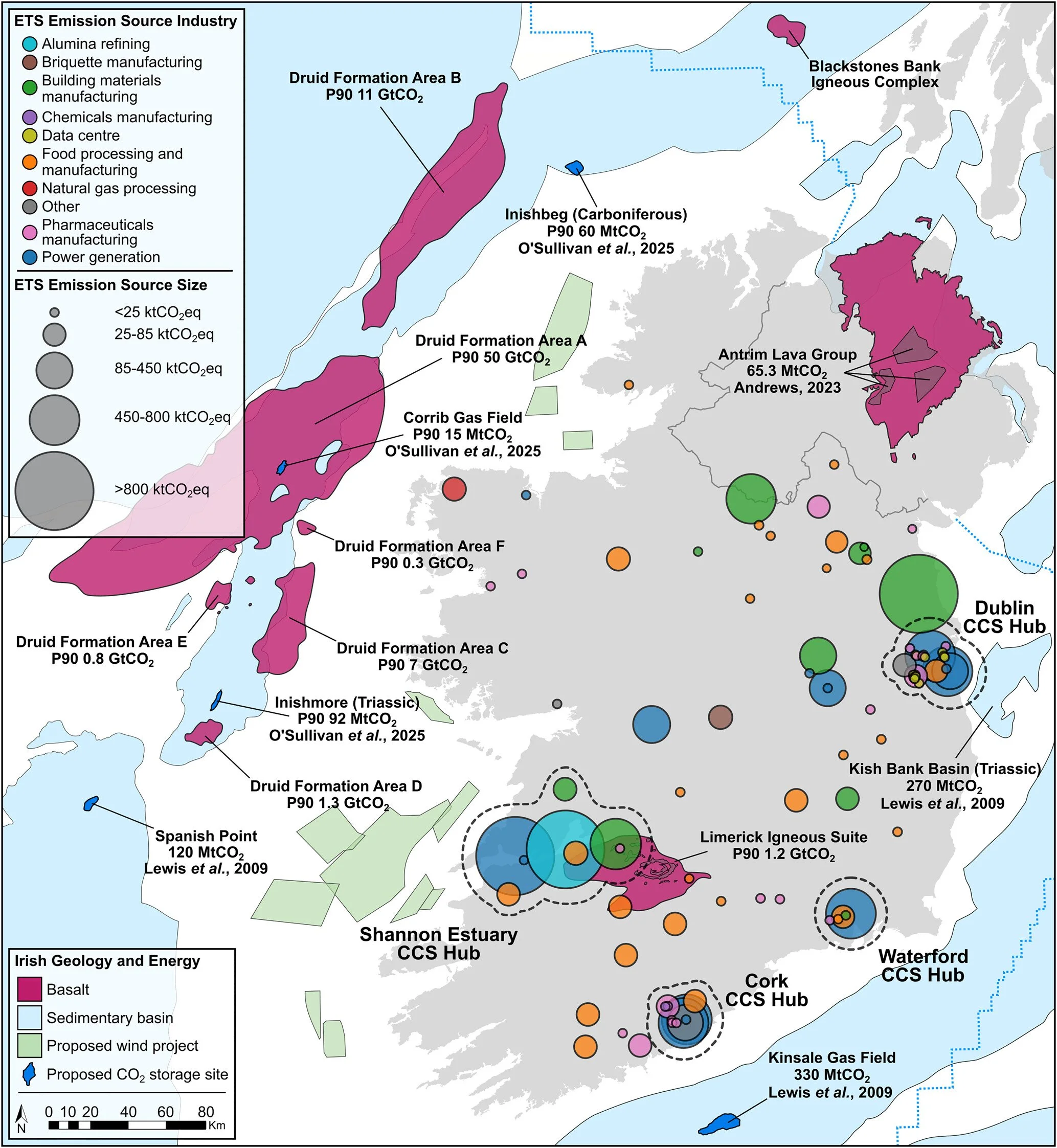
Distribution of the Limerick Igneous Suite and Druid Formation, alongside the location and scale of EU-ETS CO2-emitting entities in the Republic of Ireland and potential CCS development hubs.
Beyond the subsurface, the work incorporated a comparative assessment of onshore and offshore deployment pathways, including cost considerations, infrastructure requirements, and scalability. It also examined public perception and stakeholder dynamics, recognising that social licence is a critical factor in the viability of carbon storage projects.
Key Findings
Ireland has gigatonne-scale CO₂ storage potential
The constraint to CO₂ storage is not geological- it is systemic
Onshore storage is more cost-effective, while offshore offers larger-scale, long-term capacity
Social licence is a decisive factor
The Impact
Published as part of an interdisciplinary collaboration, this work establishes a foundation for Ireland’s future role in large-scale carbon storage. It reframes CO₂ storage as a systems challenge spanning geology, policy, infrastructure, and society, while highlighting the gap between Ireland’s climate ambition and its current legislative capacity. By supporting the development of CO₂ storage strategies and potential regional hubs, it also positions Ireland within emerging European carbon management systems.