
Advancing Geothermal Policy in Ireland: Increasing Visibility in National Energy Strategy
Unlocking geothermal energy as a missing pillar of Ireland’s energy transition
Ireland’s energy transition is heavily reliant on renewable electricity, yet heat remains one of its largest and most carbon-intensive challenges. Residential and industrial heating account for a significant share of national emissions, with over 80% of heat demand still met by fossil fuels.
While technologies such as wind and solar have transformed electricity generation, the transition to renewable heat has lagged behind. This imbalance has contributed to Ireland missing key renewable energy targets, with poor performance in renewable heat identified as a primary factor.
Geothermal energy presents a largely untapped opportunity to address this gap. Unlike intermittent renewables, geothermal systems can provide a stable, continuous source of both heat and electricity, supporting energy security while reducing emissions. Proven applications across Europe demonstrate its viability, yet in Ireland, development has been constrained by the absence of clear policy frameworks governing exploration, ownership, and deployment.
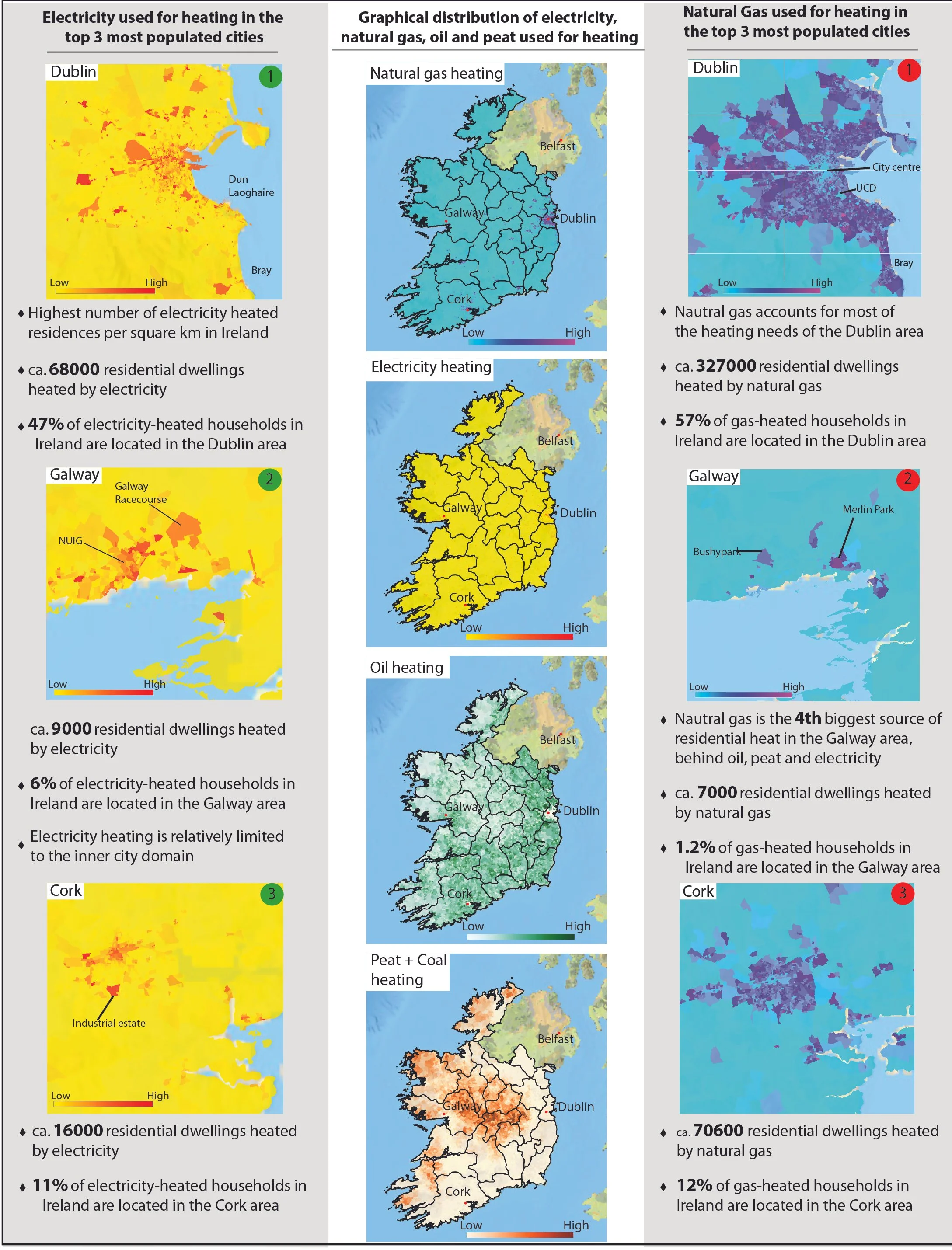
National distribution of the main fuels used for heating, as well as the use of electricity and natural gas for heating in the three most populated cities, as recorded in the 2016 Irish census (GIS data sources: Ersi, USGS, Airbus DS, USGS, NGA, NASA, CGIAR,N. Robinson, NCFAS, NLS, OS, NMA, Geodatastyrelsen, Rijkswaterstaat, GSA, Geoland, FEMA, Intermap and the GIS user community).
The Approach
This work focused on bridging the gap between geological potential and policy implementation. By translating complex subsurface data and energy system analysis into policy-relevant insights, it identified both the opportunities and structural barriers to geothermal deployment in Ireland. The work was presented directly to Members of Parliament, disseminated through parliamentary publications and media, and used to support engagement across international, cross-sectoral workshops.
The Impact
The work demonstrated that geothermal energy in Ireland is not primarily constrained by resource availability or technical feasibility, but by gaps in policy, regulatory clarity, and system-level integration.
By reframing geothermal as a policy and systems challenge rather than a geological one, it contributed to a measurable shift in how the resource is positioned within national discussions.
References to geothermal energy in parliamentary discourse increased by over 225%, alongside its impact in emerging geothermal policy and strategy development across both the Republic of Ireland and Northern Ireland.
More broadly, this highlights that unlocking energy resources depends not only on technical potential, but on aligning geology with governance, market structures, and decision-making frameworks.