
Reframing Critical Raw Materials Policy Through a Circular and Systems‑Flow Lens
Designing systems that retain critical materials, rather than lose them
The transition to clean energy and digital technologies is driving rapidly increasing demand for critical raw materials such as lithium, cobalt, and rare earth elements. Europe remains heavily dependent on external supply, raising concerns around resource security and long-term resilience. At the same time, large quantities of these materials already exist within products in use and in waste streams, particularly electronic waste. However, current systems fail to recover them effectively. Most recycling processes prioritise bulk materials, while high-value, low-concentration elements are lost due to product complexity, limited traceability, and fragmented recovery systems.
This creates a structural contradiction: materials that are considered “critical” are continuously being lost within existing systems.
The Approach
This work examined how critical raw materials move through European systems - from geological occurrence and extraction, through processing, manufacturing, and use, to end-of-life - focusing on where value is lost at each stage.
It combined geoscience, material flow thinking, and policy analysis to addressing 4 key challenges:
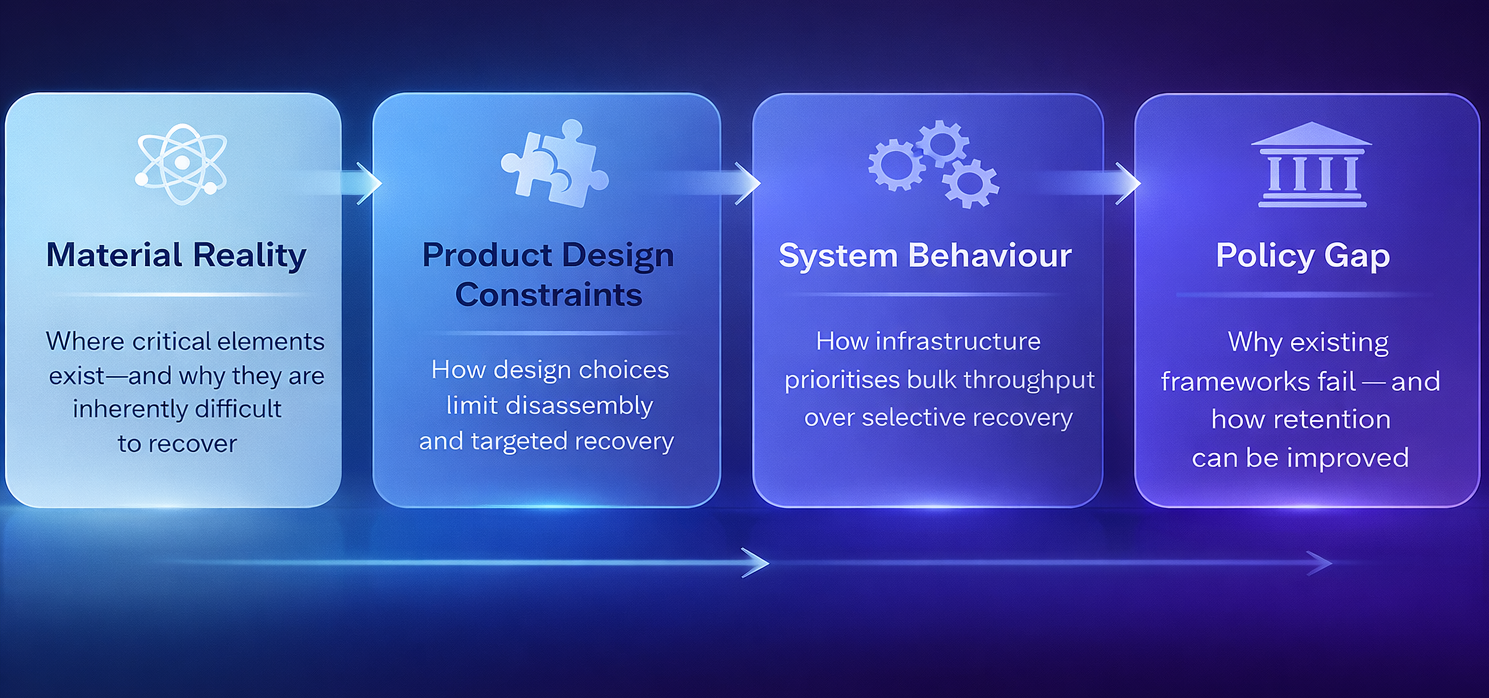
Through this integrated analysis, the work revealed a consistent disconnect between policy ambition around circularity and resource security, and the operational reality of how materials are embedded, used, and ultimately lost within products and processes. While policy frameworks emphasise recycling and waste reduction, the systems in place are not designed to recover critical materials effectively — they are designed to process waste!
This insight led to a shift in framing: from improving recycling performance to redesigning systems for material retention. In response, the work introduced the concept of forwardcycling, which focuses on retaining critical materials within engineered systems rather than allowing them to dissipate through conventional recovery pathways.
This approach centres on designing products with known and recoverable material compositions, embedding traceability and material awareness across the product lifecycle, and developing targeted recovery pathways for specific elements rather than relying on bulk recycling processes. It also emphasises aligning policy, industry, and data systems to enable intentional, value-driven recovery of critical materials.
Rather than treating waste as an endpoint, this perspective recognises materials as assets that must be actively managed, tracked, and retained throughout their lifecycle.
The Impact
The work demonstrated that the primary limitation in Europe’s critical raw materials system is not a lack of resources, but a lack of system-level integration. Critical materials are present across products and waste streams, yet they remain untracked, undervalued, and systematically lost within existing recovery systems.
This led to a reframing of the problem from improving recycling performance, to redesigning systems for material retention. It highlights that increasing recycling rates alone will not secure critical material supply, particularly for high-value, low-concentration elements that are not captured by conventional processes.
At its core, the work identifies three key insights:
Over 60% of all ewaste in the EU is unaccounted for each year
Without accounting for CRM in product manufacturing, the “circular” economy remains linear and unsustainable
The constraint to resource security is not resource availability, but system design
The introduction of the forwardcycling concept provides a practical pathway for addressing this gap, positioning material retention as a design, policy, and systems challenge rather than a purely technical one. This contributes to ongoing discussions around EU critical raw materials strategy, circular economy implementation, and resource security, particularly in the context of reducing dependency on external supply chains.
More broadly, the work demonstrates that achieving a truly circular economy depends on integrating geology, product design, policy, and industrial systems into a coordinated framework—one in which materials are not only used efficiently, but deliberately retained.