
REE Exploration is Being Framed Wrong... and the Smart Money Knows It
By Nicholas Vafeas
Published 2 May 2026
At a Glance
The Core Fallacy: The market currently prioritizes processing simplicity, which has pushed ion-adsorption clays (IACs) into the strategic spotlight due to their low-intensity leaching and lower initial capital expenditure.
The Structural Bottleneck: IACs are geographically constrained, lower grade, and environmentally vulnerable at scale. True resource security requires shifting focus toward hard-rock systems, such as highly fractionated pegmatites, which offer the scale and predictability required for multi-decadal supply chains despite their processing complexity.
The Strategic Solution: Upstream operators and investors must transition from surface-focused regolith mapping to deep-seated mineral systems models. The highest-value opportunities sit in the unmapped transition zones, where weathered pegmatites feed clay systems and mask massive hard-rock potential beneath.

A massive, well-formed corundum crystal sitting on the surface - a testament to the extreme elemental concentration and unique mineralization potential found within highly fractionated LCT pegmatite systems.
The Allure of "Process-Easy" Deposits
I have a particular fondness for LCT (lithium, columbite, tantalite) pegmatites, especially since they're associated with so many incredible minerals (like the giant, man-sized corundum in the cover image). So, for me it has been quite noticeable that over the past few years there’s been a consistent pattern in how rare earth element (REE) projects are discussed, across reports, investments, and even policy conversations.
The focus almost always lands on processing simplicity, and understandably so. Why go for the harder option first? That is exactly why ion-adsorption clays (IACs) have taken centre stage. On paper, they are compelling:
You do not need crushing or complex mineral liberation.
The REEs are weakly bound to clays, meaning they can be recovered through relatively low-intensity leaching.
Lower capex, simpler flowsheets, faster timelines, all things the market tends to reward early.
To be clear, that logic is not wrong, but it is incomplete, and it is a pattern the western world keeps falling into.
The System-Level Breakdown of Clay Systems
When you zoom out beyond individual projects and look at the system-level challenge, a different picture starts to emerge. REE supply is not just a processing problem, it is a resource security problem. That is where this current “process-easy” narrative begins to break down.
Ion-adsorption clays are geographically constrained. They rely on very specific weathering environments. They are often lower grade, sometimes discontinuous, and increasingly exposed to environmental scrutiny, particularly around leaching and land use. In isolation they work, but at scale they struggle.
The Hard-Rock Pivot: Consolidating Pegmatite Architecture
Meanwhile, something quieter is happening in the background. Hard-rock systems, particularly evolved pegmatites, are being consolidated, especially across East Africa. Not because they are easy, they are not. They require crushing, flotation, and often complex downstream processing. But they offer something IACs typically do not:
Scale
Predictability, and
Long-term supply potential.
From a geological perspective, this makes sense. Highly fractionated pegmatites act as sinks for incompatible elements, including REEs. The mineralisation is primary, not redistributed. And while processing may be significantly more difficult, the system itself is more robust.
Shifting Mindsets: Regolith Mapping vs. Igneous Fertility
This is where I think the real shift is happening. We are moving from a market that rewarded ease of extraction to one that increasingly values control of supply. That changes how exploration should be approached, especially when geopolitical interests are at stake.
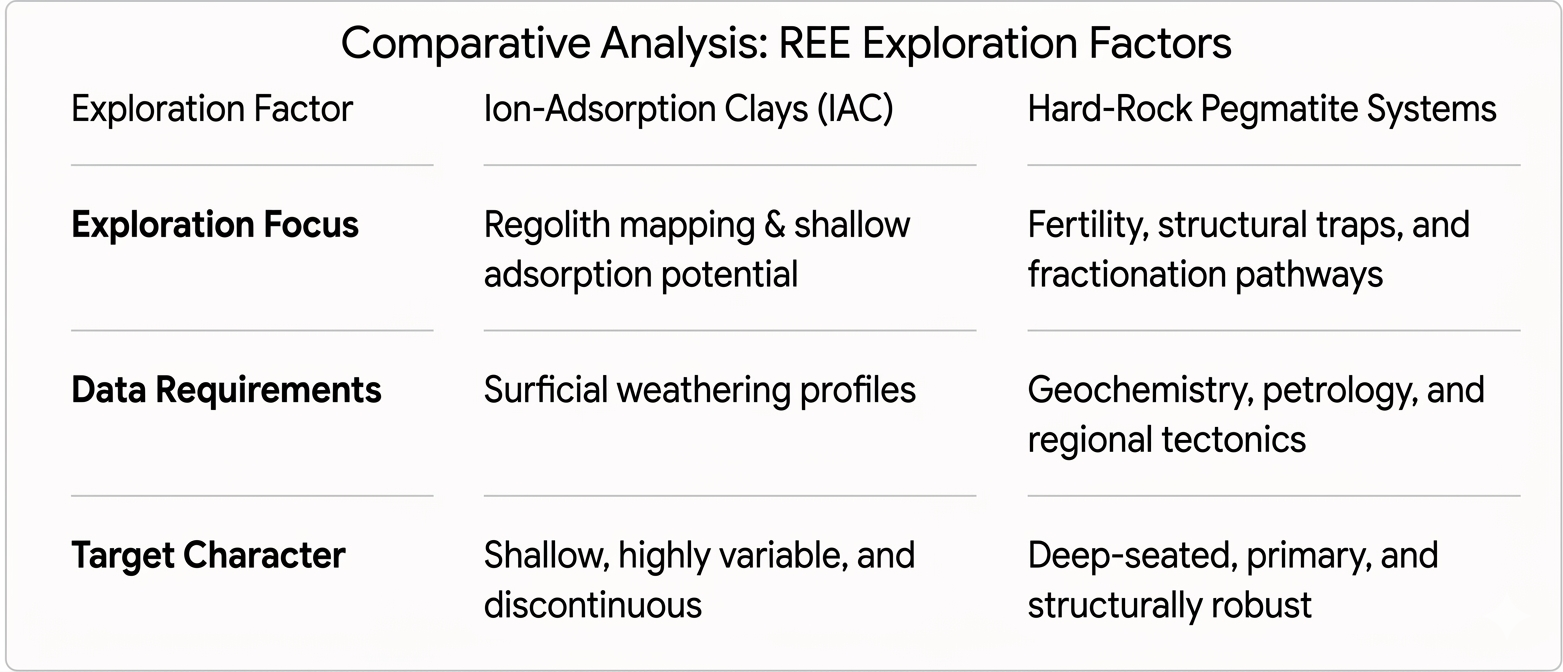
A comparative analysis of the distinct technical parameters, data required, and geological mindsets involved in exploration for superficially simple ion-adsorption clays versus large-scale, deep-seated hard-rock REE systems.
These are very different mindsets!
The Space in Between: Finding Overlooked Value
What is particularly interesting from an exploration standpoint is the space in between. Weathered pegmatites feeding clay systems, regolith enrichment above hard-rock sources, and multi-stage mineral systems that do not fit neatly into one category. A good friend of mine works in this space, visually tracing clay signals to find deeper seated pegmatites, and that is where a lot of the overlooked opportunity likely sits.
Ultimately, the energy transition does not care what is easiest to process. It cares about what can reliably supply material at scale. If demand continues on its current trajectory, the question will not be which deposit type is simpler. It will be which systems can actually deliver, consistently, over decades...
...and who controls them.