
The “Hidden 50%” Problem: Why We Are Misreading the Future of Rare Earths
By Nicholas Vafeas
Published 05 May 2026
At a Glance
The Core Fallacy: Modern critical mineral exploration and global resource forecasts rely on heavily biased spatial databases. Algorithms and exploration teams are trained to prioritize highly visible, circular anomalies (plugs and ring complexes) while overlooking subtle structural expressions.
The Structural Bottleneck: A comprehensive global review of 551 carbonatite occurrences shows that roughly half (48%) are primarily expressed as single dykes or thin dyke swarms. Because these architectures are subtle and thin, they suffer from a systemic exposure bias, leaving a massive portion of the world’s true deep-seated mineral plumbing entirely unmapped.
The Strategic Solution: Boardrooms and exploration teams must transition from simple target-matching models to system-level architecture analysis. True discovery breakthroughs in the next decade belong to operators who leverage field-experienced structural geology to identify unconventional chemical signatures hidden within subtle lineaments.

The distinct iron-rich terracing of the Vergenoeg open-pit operation - a prime example of a complex, primary mineral system whose deeper architecture connects to a broader regional structural family.
Exposure Bias in Critical Mineral Security
I recently came across a brilliant infographic and review paper Walter et al. 2026 that attempts to bring visual structure to something that often feels inherently chaotic: Carbonatites.
To the uninitiated, these are the "oddballs" of geology. They are rare, carbonate-rich igneous rocks that host the lion's share of the world’s Rare Earth Elements (REEs) and Niobium. In many ways, they are the engine room of the green energy transition. But as I studied the architecture of the 551 systems analysed in this review, I realised there is a lesson here that applies far beyond the rock face. It is a lesson about exposure bias, and it explains why our current models for critical mineral security might be fundamentally flawed.
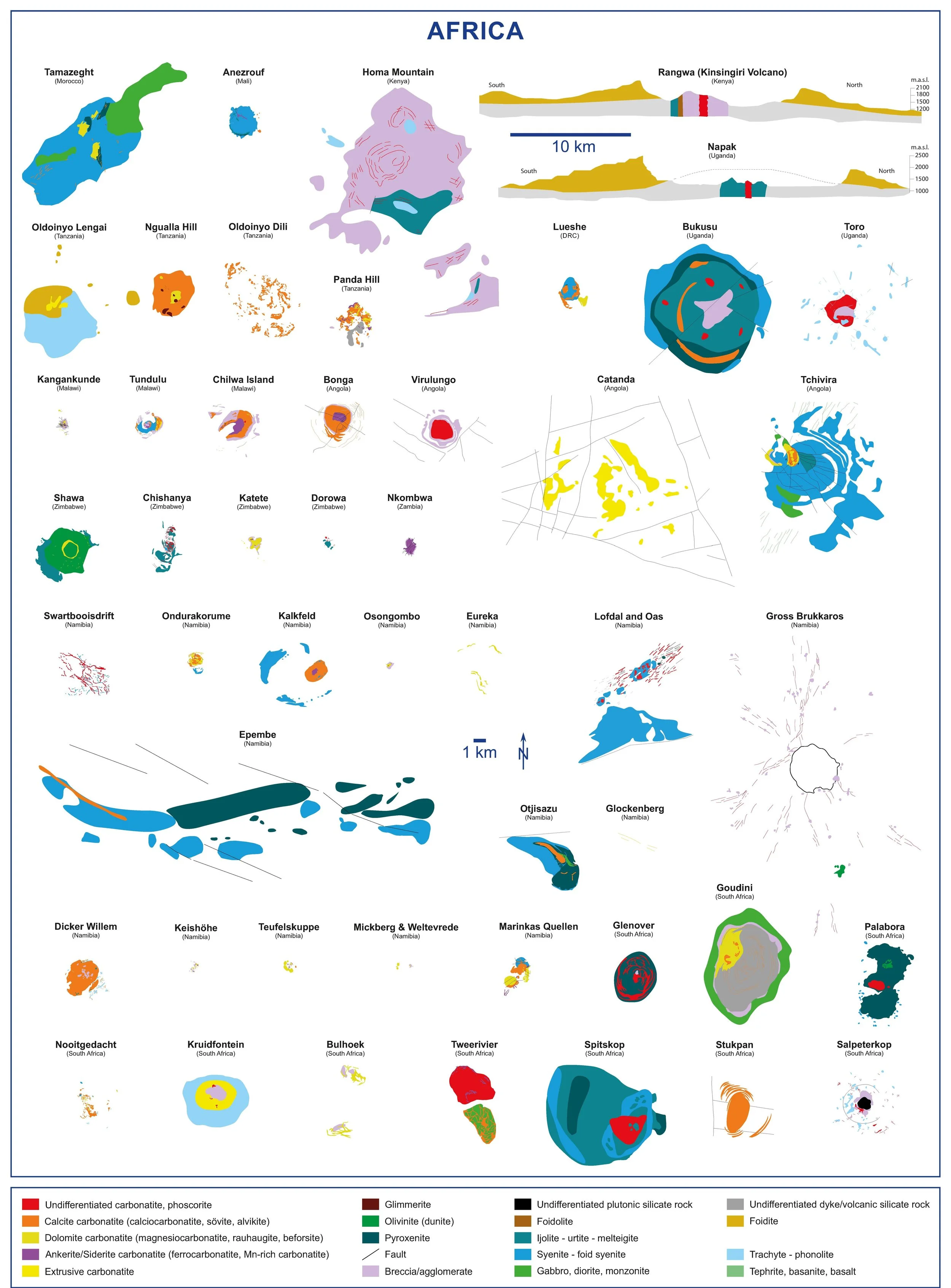
Architectural variations of 551 African carbonatite systems analyzed by Walter et al. (2026), demonstrating the structural disparity between flashy ring complexes and subtle, hidden dyke networks.
Complexity is often just incomplete visibility
In the exploration world, we have a habit of looking at things in isolation. We find a "deposit," draw a box around it, and treat it like a static prize waiting to be extracted.
But as the architecture of these systems illustrates, they are anything but static. They are vertically dynamic, fast-ascending, and structurally controlled. These don't behave like typical magmas that pond and spread slowly. Instead, they act more like a jackhammer, punching through hundreds of kilometres of crust with high speed and incredibly low viscosity.
What we call "complexity" in these deposits is usually just the parts of the system we haven't seen yet. The "deposit" we mine is often just a tiny, visible snapshot of a massive, high-energy process. If we only study the snapshot, we miss the movie.
The “Hidden 50%” and the trap of exposure bias
What’s most striking, is that nearly half of all studied carbonatites are expressed primarily as single dykes or dyke swarms.
Why does this matter? Because in the hierarchy of exploration, we tend to chase the "flashy" geometries. We look for the big, circular ring complexes and plugs that show up clearly on satellite imagery and magnetic surveys. These are the Mount Welds and the Mountain Passes of the world.
But the "Hidden 50%" (i.e. the dyke swarms) are the plumbing of the system. Because they are thin and subtle, they are vastly underrepresented in our global databases. We have a systemic exposure bias. We value what is easy to see, and we often ignore the subtle signals that indicate a much larger system hiding just out of sight. In mining (and in global supply chains) what you don't see is often what ends up breaking your model.
I remember visiting the Vergenoeg mine during my PhD and being struck by the connection between it and Phalaborwa. They are separated by hundreds of kilometers, yet they share a structural DNA.
However, it was the differences that fascinated me most. While they belong to the same broader family, Vergenoeg is a fluorite-iron oxide pipe where the rare earth mineralogy is dominated by microcrystalline monazite and xenotime.
This brings us to a critical commercial reality: the smaller extensions of these systems don't look like their larger parents. As these systems move through the earth, they change. If your exploration team is looking for a carbon-copy of a known "flagship" deposit, you will likely walk right over a world-class asset simply because its chemical fingerprint doesn't match the textbook. In short, searching for "more of the same" is a recipe for missing the next big discovery.
It reminded me of a broader principle, that sometimes the best way to see detail is to first step back to a scale where the detail isn't visible. It’s like staring at the night sky to predict the movement of a single star. You need the context of the entire sky.
The Supply Chain Conundrum: Are we betting on the wrong horses?
This isn't just a geological debate, it’s a boardroom crisis. The vulnerability of our supply chains is often tied to our narrow understanding of where these minerals come from. If our best global compilations are still missing the hidden parts of these systems due to exposure bias, how confident can we be in our global resource forecasts?
In the race for REEs, we focus almost exclusively on flagship deposits. But clearly carbonatites don't operate as single, isolated bodies. By ignoring the system architecture, we run three major risks:
Chasing the wrong signals: We look for ring structures when the real volume might be sitting in unrecognised dyke swarms.
Underestimating potential: We assume a system is small because its surface expression is subtle, failing to realise it might be a deep-seated giant like Phalaborwa, which is exposed at depths of up to 15km.
Predictability collapse: In a global supply chain, predictability is everything. If we don't understand the process (i.e. how these melts ascend and where they pond) we can't properly predict where the next undiscovered tier-one asset will be.
The human element
The takeaway here is simple. The value isn’t just in identifying a deposit, it’s in understanding the architecture of the system to which it belongs.
We are currently seeing a surge in "AI-led" exploration, where algorithms are trained to hunt for known patterns and circular anomalies. But an algorithm is only as good as the database it feeds on, and our current databases are heavily skewed by exposure bias. To find the "Hidden 50%," we need to move beyond blind data-crunching and acknowledge human experience, namely our ability to recognise our own lack of understanding.
The real breakthroughs in the next decade of exploration won't come from just finding more of the obvious 50%. They will come from the people who have the vision to find the hidden half.
Because in the end, the rocks haven't changed, so our perspective must.