
Can We Stop Treating Every Pegmatite Like a Lithium Lottery Ticket?
By Nicholas Vafeas
Published 12 May 2026
At a Glance
The Commodity Fallacy: In the rush for battery metals, the broader market frequently treats pegmatites as a singular deposit family with variable grades. In reality, they represent two fundamentally distinct magmatic genetic pathways.
The Genetic Divide (LCT vs. NYF):
LCT (Lithium-Cesium-Tantalum): Products of crustal recycling born from ancient, collisional, compressional orogenies. They yield S-type, reduced magmas enriched in battery metals.
NYF (Niobium-Yttrium-Fluorine): Products of mantle influence born from extensional, rifting environments. They yield A-type, oxidized, fluorine-rich magmas enriched in magnet rare earth elements (REEs).
The Strategic Implication: Chasing spodumene in an NYF rift system, or ignoring high-value heavy REEs in an alkaline complex, represents an expensive misallocation of exploration capital. Explorers must utilize geochemistry (specifically K/Rb and Nb/Ta ratios) to determine system architecture before deploying drill rigs.
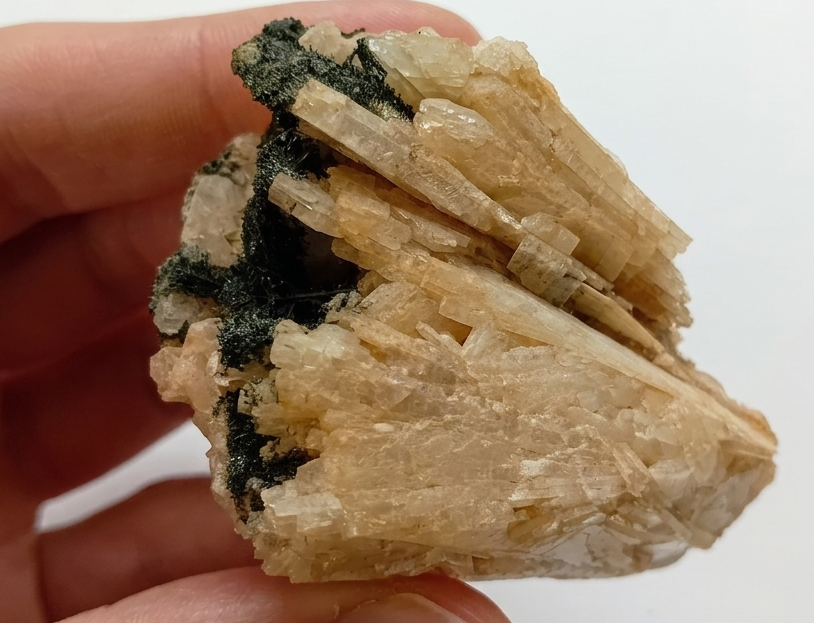
Tourmaline overgrowth on crystalline spodumene within a highly evolved pegmatite sample. Spotting these precise mineralogical signatures early serves as an essential field proxy for diagnosing internal system evolution.
The Surviving "Spray and Pray" Approach
For a long time, pegmatite exploration was treated almost like geological prospecting by coincidence. You’d find a coarse-grained granite, grab a few samples, and pray for spodumene.
For many companies, in the heat of a lithium cycle, that “spray and pray” approach still quietly survives. When money moves faster than the geology, people start seeing every pegmatite as a potential payday. But in reality, if you’re treating pegmatites as a single family of deposits, you’re making a fundamental (and potentially expensive) mistake.
Modern exploration has mostly moved past guesswork and shifted into a predictive era, and at the center of that shift is one distinction that changes everything: LCT vs. NYF.
Putting the academic jargon aside, this is the framework that determines whether your project is a lithium powerhouse or an REE treasure chest. And that’s exactly why you shouldn’t use the same playbook for both.
Pegmatites Are Not a Single Deposit Type
Most geologists understand this, but believe it or not, it is not widely known across the broader market. In fact, one of the biggest misconceptions I keep seeing is the idea that all pegmatites are essentially the same “stuff,” just with different grades.
They really aren’t.
Pegmatites are the “last gasp” of a cooling magma body. But the source of that magma dictates what metals you’re going to find, in the same way that adding sugar or salt to your dough determines whether you’re making cake or bread. You can bake that dough as long as you want, but the ingredients you started with dictate the final result (As a sourdough guy, I take this analogy very seriously.)
In our case, you can think of LCT (Lithium-Cesium-Tantalum) pegmatites as “Crustal Recycling” and NYF (Niobium-Yttrium-Fluorine) pegmatites as “Mantle Influence.”
Everything from where you drill to what pathfinders you track starts with knowing which “family” you’re dealing with. If you are looking for sugar in a dough made of salt, you are going to be drilling expensive holes for a very long time.
LCT: The Product of Ancient Collisions
When I look at LCT systems like Greenbushes or Ewoyaa, I’m looking at the result of massive tectonic collisions, where continents collided, thickening the crust and essentially forcing old sedimentary rocks to melt.
Because these source rocks have been through the rock cycle for billions of years, they’re already enriched in things like Lithium, Cesium, and Tantalum. These are S-type granites, full of muscovite and tourmaline, and they are your primary hunting ground for hard-rock lithium.
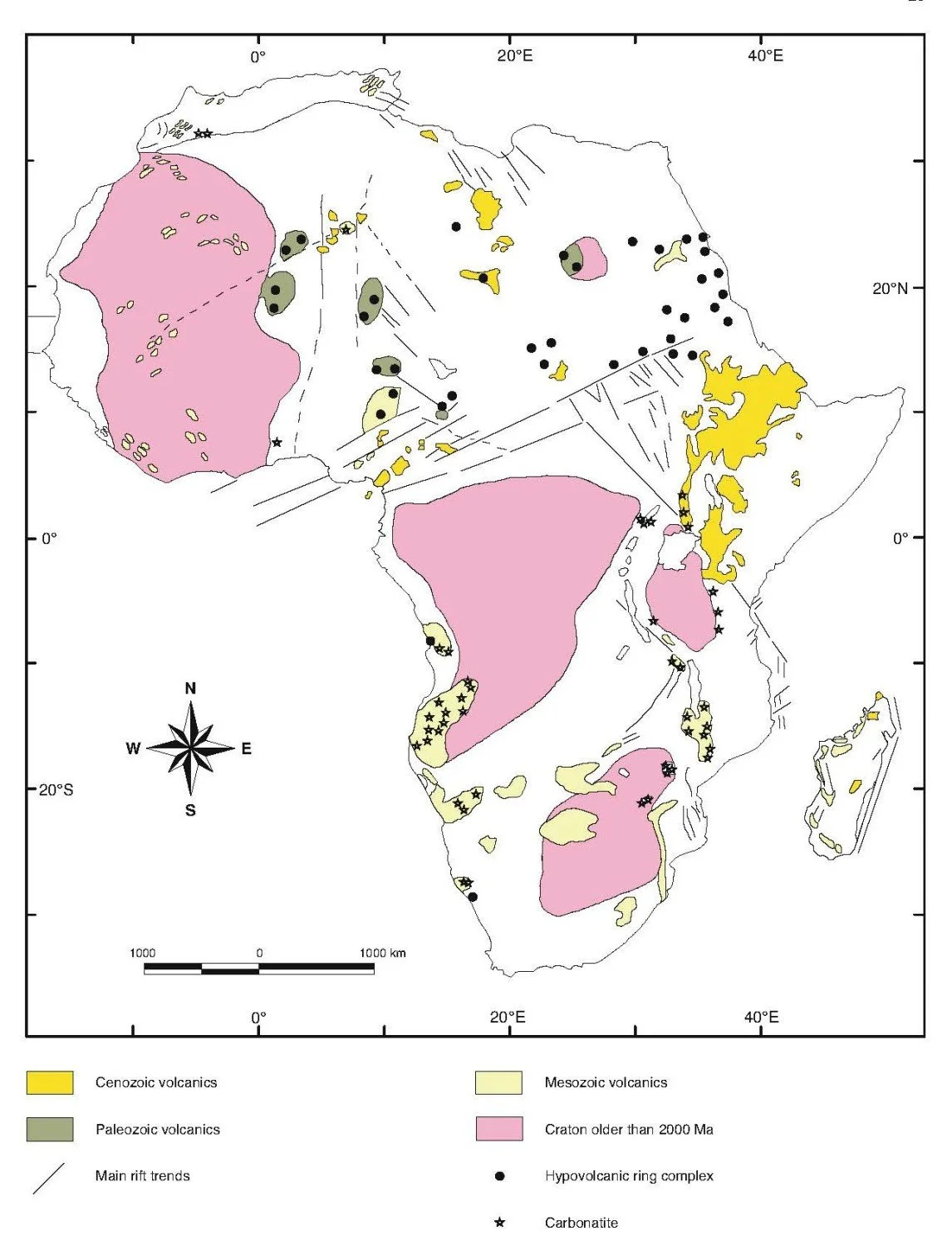
Major magmatic provinces and tectonic frameworks across the African continent (Schlüter, 2006). This structural context illustrates why modern rift lineaments cutting through ancient, collision-thickened crust can expose lithium-enriched lithium-cesium-tantalum (LCT) basements.
LCT magmas also tend to be reduced. I won’t dive too deeply into the chemistry, but this helps create the kind of evolved crustal melt where lithium can become extremely concentrated.
If your regional geology is dominated by ancient crustal thickening and continental collision, then you’re in the LCT game.
NYF: The Extensional Wildcard
NYF systems belong to a totally different world. They don’t want a collision, they want a rift. These systems form when the Earth is pulling apart, allowing hotter, deeper magmas (A-type granites) to rise.
These magmas are usually more oxidised and loaded with Fluorine. Because of that chemistry, they don’t care much for lithium, and instead concentrate Niobium, Yttrium, and Rare Earth Elements (REEs).
If you’re looking at a rift zone or an alkaline complex (think Songwe Hill or Strange Lake or Thor Lake) and you’re still hunting for spodumene, you’re likely ignoring the REE fortune sitting right under your nose.
Now Let Me Throw a Small Spanner in the Works
If I just said that LCTs like collisions, why is there a massive LCT province right along the East African Rift? On the surface, a rift is the exact opposite of a collision. It is the Earth pulling apart. So why the lithium?
Because geology is ultimately about time and context.
While the Rift itself is geologically “young,” it is cutting through extremely ancient crust that formed during massive continental collisions hundreds of millions to billions of years ago. The Rift is simply the latest event exposing these older, deeper treasures.
Mineralogy is your first “smoke signal.” It tells you whether your exploration model is actually fit for purpose. If you see minerals like Spodumene or Lepidolite, you know you’re looking at the “sugar” of an ancient LCT system, regardless of the modern Rift valley sitting on top of it.
Which Way Do I Go?
If you’re a manager or investor, this is the part that should keep you up at night.
This is where geochemistry becomes your compass. These elemental ratios can guide you directly toward the most fertile parts of a system. For lithium exploration, one of the biggest things geologists look for is how “evolved” a magma system is (basically, how concentrated and chemically refined it became as it cooled).
For LCT (Lithium) exploration, it’s all about that sweet K/Rb ratio. As the magma becomes more evolved, that ratio drops. There’s good chemistry behind why this happens, but the simple version is that a low K/Rb ratio is often a strong sign you may be getting closer to lithium-rich pegmatites.
For NYF (REE) exploration, the golden compass is Nb/Ta, with a huge focus on Fluorine. In these systems, fluorine acts like the “taxi” transporting Heavy Rare Earths and other exotic metals through the magma.
If you aren’t mapping fluorine-rich and alkaline alteration, you’re not really exploring, you’re just wandering.
Why This Matters for the Bottom Line
From an investment standpoint, the LCT-NYF distinction is the ultimate risk-management tool. You can have the best drillers in the world, but if the system was “coded” for REEs from the start, you won’t find a spodumene giant there. As the industry moves toward system-based exploration, good teams are no longer just looking at pegmatites, they’re looking at geological systems.
The point I’m trying to make is that LCT and NYF aren’t just two types of rock. They are two fundamentally different ways the Earth concentrates value.
To put it really simply:
Collisions for batteries.
Rifting for magnets.
Understanding the difference early doesn’t just make you a better geologist, it makes you a better steward of capital. In a highly competitive world hungry for critical minerals, we can’t afford to spend time or money chasing the right metal in the wrong system.