
Critical Minerals Strategy and the Illusion of Supply Chain Control
By Nicholas Vafeas
Published 27 April 2026
At a Glance
The Core Fallacy: Modern geopolitical initiatives (specifically led by the United States) operate under the assumption that securing international mining access directly translates into supply chain control. In reality, access to raw mineral units does not equal systemic dominance.
The Structural Bottleneck: True supply chain leverage does not sit at the point of extraction; it is concentrated downstream in the technically demanding, capital-intensive phases of chemical processing, refining, and separation. Expanding upstream mining capacity without building parallel domestic refining infrastructure merely accelerates material into an external, highly centralized processing ecosystem, reinforcing the very dependencies these policies aim to eliminate.
The Strategic Solution: Meaningful resource security requires treating critical minerals as an integrated system. Strategic planning must pivot away from short-term extraction deals and focus on long-term, non-dilutive funding for domestic scientific infrastructure, advanced chemical engineering networks, and pilot refining facilities.
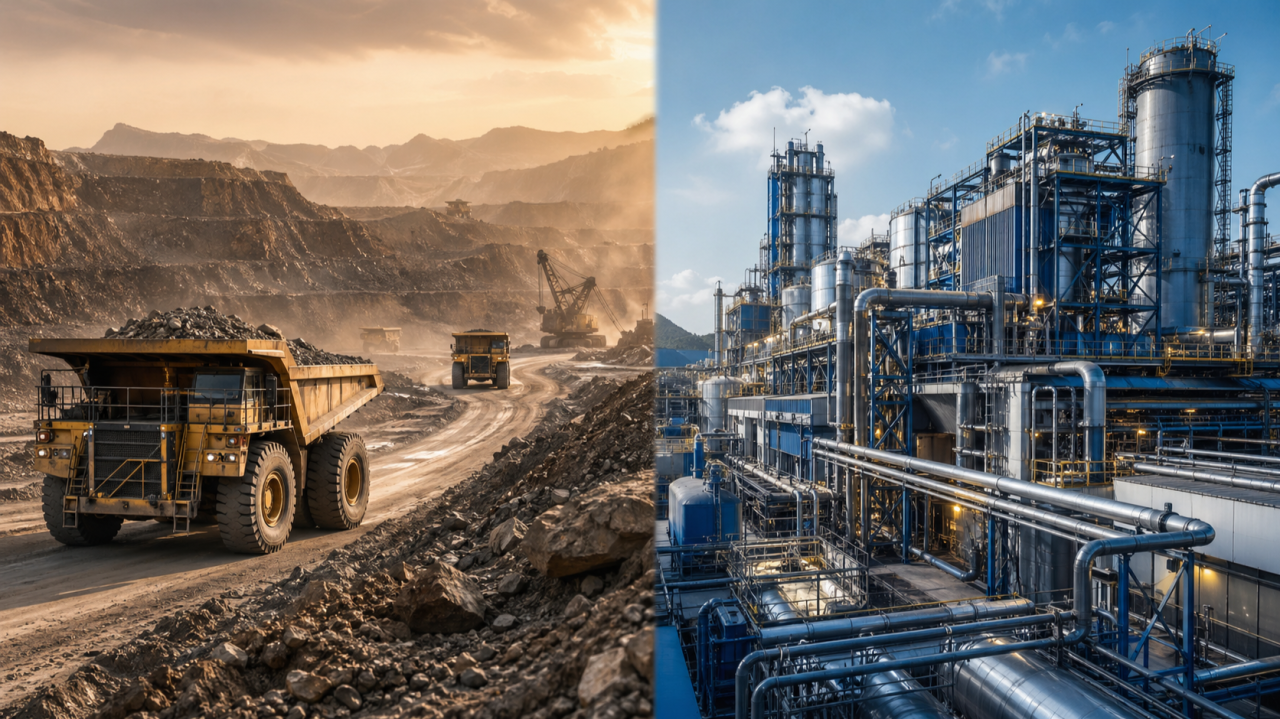
The strategic disconnect in critical mineral supply chains: upstream resource extraction (left) vs. the highly capital-intensive, technically complex downstream chemical refining and separation infrastructure (right) where actual value and control reside.
Patterns of Strategic Diversification
Over the past week, I’ve found myself noticing the same pattern again and again. Different headlines, different geographies, but the underlying signal is consistent. The United States is moving decisively to secure access to critical minerals.
Phalaborwa in South Africa. Serra Verde’s Pela Ema operation in Brazil. Deepening cooperation with the European Union. On their own, each of these developments is notable. Taken together, they are something else entirely. Coordinated, intentional and hard to miss if you’re paying attention. This is not subtle, It is strategy.
At its core, the approach is straightforward: diversify supply, reduce dependence, and secure upstream access. Of course this aligns neatly with the broader Critical Raw Materials agenda and, at a high level, it makes sense. If supply chains are vulnerable, you widen the base. That creates options and reduces concentration risk. No real disagreement there. But there’s an assumption embedded in this approach that we keep coming back to, because it keeps showing up, and because it’s where things start to drift from how these systems actually work.
The Extraction vs. Control Fallacy
There seems to be a thinking that access to mining of raw materials leads to control over supply chains. In practice, those are very different things.
You can secure mining projects, sign offtake agreements, and invest across multiple jurisdictions. But none of that, on its own, guarantees control over how materials flow through the system. That control doesn’t sit at the point of extraction. It sits further downstream, in places that tend to get less attention but carry far more weight. Processing. Refining. Separation. The less visible parts of the value chain, which also happen to be the most complicated ones. These are the stages that turn ore into something actually usable. They are technically demanding, capital-intensive, and (importantly) where most of the value is created. They’re also where dependencies become entrenched, often quietly and over long periods of time.
The Midstream Bottleneck: The Case of Nickel and Rare Earths
I’ve written before about the mismatch in U.S. in metal value chain before (using nickel flows as an example). The gap between what is imported and what is exported in processed form is a useful visual because it makes the dynamic tangible. Access to mineral units exists, but the ability to locally convert those units into higher-value products at scale is far more limited. The material moves, but the value (and the control) doesn’t necessarily stay.
Nickel is just one case. You see similar patterns across rare earths, lithium, graphite. Different materials, same underlying constraint.
The bottleneck isn’t getting the rock out of the ground, it’s what happens next. This is where the current trajectory starts to look a little contradictory.
Expanding mining capacity without building parallel processing capability doesn’t secure a supply chain. If anything, it can accelerate the opposite outcome. More upstream access simply means more material entering a system that still depends on external processing. The geography of extraction changes, but the structure of dependency does not.
I tend to think of this as a form of pseudo-control. Everything looks more diversified on paper. There are more projects, more partnerships, more announcements. But when you follow the material through the chain, you end up in the same places for the steps that actually matter.
That’s not resilience. It just feels like it.
The Policy Mismatch: Eroding Our Scientific Infrastructure
What makes this more difficult to reconcile is the policy backdrop. On one hand, there is clear momentum behind securing international access to critical minerals (great!). On the other, there are signals (particularly around funding) that suggest less emphasis on the capabilities required to build downstream strength.
Proposed cuts to science and research agencies, especially those tied to energy, materials, and industrial innovation, stand out here. Not because they dominate headlines, but because of what they imply over time. A substantial reduction to the United States Geological Survey and its underlying scientific infrastructure, including major cuts to core science systems, natural hazards, and the effective elimination of ecosystem-focused research (among others). Whilst there is selectively increased funding for mineral resources and energy resources, in practice, it means greater emphasis on identifying and accessing raw materials, but reduced capability to support the environmental, technical, and data-driven requirements needed to process and refine them efficiently, thus reinforcing bottlenecks further along the value chain rather than resolving them.
Processing and refining aren’t static capabilities. They evolve. They depend on advances in chemistry, engineering, and process design. They require skilled workforces, pilot facilities, and a willingness to invest in things that don’t pay off immediately. In fact they’ll only really pay off once we’ve all long forgotten the headlines. But you simply can’t shortcut that layer. I’ve never seen it work.
If the strategy depends (explicitly or implicitly) on technological leadership in these areas, then the supporting ecosystem has to be there. Research, standards, innovation networks. Not as an afterthought, but as a core component. Otherwise, you end up with a system that’s pulling in different directions. Kind of like opening a bakery without an oven. You can buy all the ingredients you want, but you still have to pay someone else to bake it.
Leverage Belongs to Capability
In my experience, resource strategy only really works when it’s treated as an integrated system. Geology, processing, policy, and markets all interacting, all aligned. overlook one of these, and the rest don’t quite hold. You can compensate for a few years, but the weaknesses tend to surface eventually, ultimately becoming a problem for others to bear. And usually at the worst possible time.
The countries that will end up with meaningful control over critical mineral supply chains won’t just be the ones that mine more, or even the ones that secure the most deals. They’ll be the ones that build and maintain capability where it counts. Processing capacity, technical expertise and consistent investment over long time horizons.
It’s less visible work, less headline-driven, but structurally, it’s what matters. As demand for these materials continues to accelerate (driven by electrification, energy systems, and advanced manufacturing) that distinction becomes harder to ignore. Access will still matter, of course. But capability will matter more. That’s where the real leverage sits, and it’s where the current gap is hardest to overlook.
There is clear intent behind the push to secure critical minerals globally. The activity is real, and in many ways (from a geologist’s perspective) overdue. But the underlying assumption (i.e. that upstream access translates into supply chain control) still lingers in how the strategy is being executed.
It doesn’t. Not on its own.
Control is built further along the chain, in the parts that are slower to develop and easier to underinvest in. It’s reinforced through alignment between policy, industry, and technology, and through a willingness to treat these supply chains as integrated systems rather than discrete opportunities. Until that alignment is fully in place, there’s a risk that current efforts deliver diversification without true resilience.
That may be a subtle distinction, but it’s an existential one.