
THE FALL OF GEOSCIENCE
An unintended consequence of well-intended climate advocacy
By Nicholas Vafeas
Published 6 November 2023
At a Glance
The Core Problem: Well-intended climate advocacy and progressive EU decarbonization policies have inadvertently triggered an alarmist media narrative ("Mining = Bad"). This public backlash has severely depressed interest in traditional Geoscience, leading to a dangerous 40% global decline in geology graduates over the past eight years.
The System Failure: A fundamental disconnect exists between Western environmental activism and the raw physical realities of green technology. Achieving the EU’s Critical Raw Materials Act mandate (sourcing 10% of critical minerals locally by 2030) or net-neutral emissions by 2050 is impossible without massive local mineral extraction. Activist blockades and the rapid decline in geo-engineering talent threaten to completely stall the renewable infrastructure transition. Furthermore, aggressively shutting down natural gas processing blind-sides critical secondary supply chains, such as the global supply of Helium, which is vital for medical MRIs and advanced manufacturing.
The Solution: Governments, institutional funders, and climate advocates must treat Geoscience as an indispensable pillar of environmental sustainability rather than an adversary to it. True climate resilience requires building systemic scientific literacy across all disciplines to support both responsible, localized critical mineral supply chains and the next generation of earth science researchers.
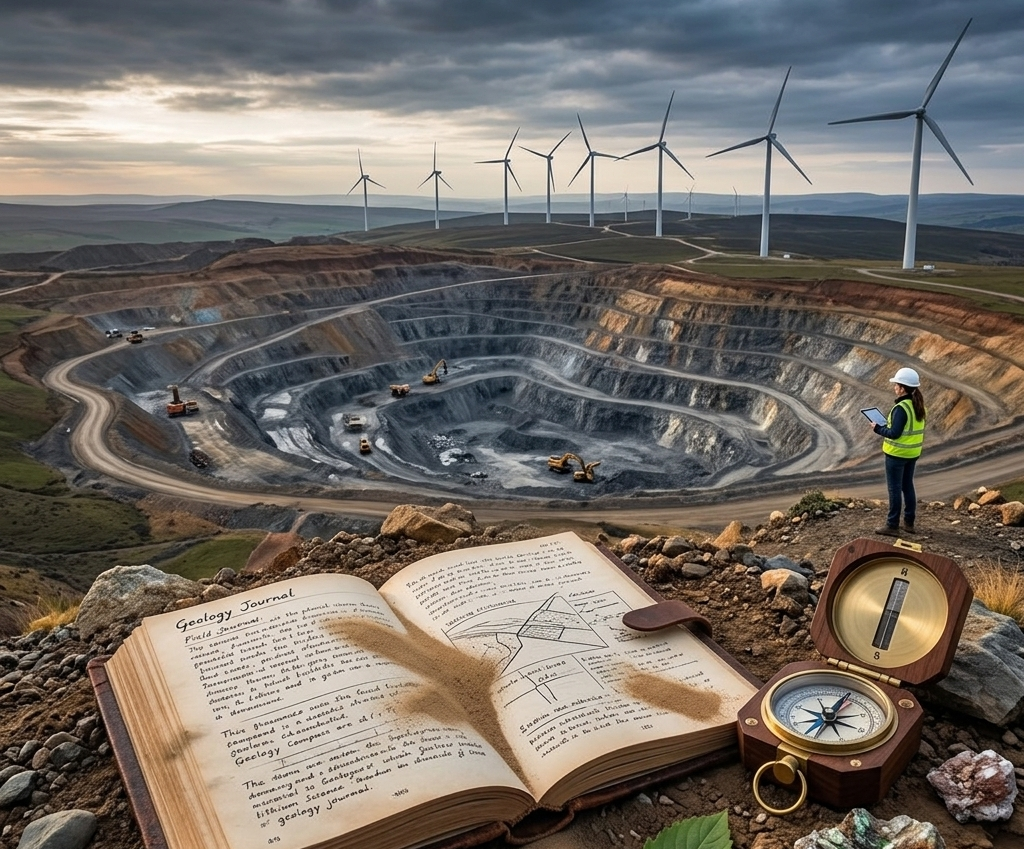
The Green-Mineral Paradox: A visual representation of the critical dependency of renewable infrastructure on traditional mineral extraction, highlighting why the clean energy transition is physically impossible without active geoscience mapping.
The increase in climate-focused research over the past few decades has brought about many (often uncomfortable) insights into our daily consumption habits. Our choices, from how we get around, to what we eat, have been scrutinised, leading to increased awareness of our own carbon footprint. Our understanding of our carbon impact has not only influenced our personal lifestyles but has also leaked into the realms of politics and media, notably exemplified by the film "Don't Look Up", where an astronomy professor (played by DiCaprio), tries to convince a self-obsessed world of impending doom (a good film actually!). Bar the dramatic (if not realistic) theme, this film underscores the importance of understanding the role of science in society. Our ambition to reduce our carbon impact has led to many progressive EU waste and emissions policies aimed at curbing our use of fossil fuels. But one ancient branch of science is not fairing so well in this transition – Geoscience!
An alarming trend has emerged in developed nations, particularly those with limited local ore reserves to exploit. There is a noticeable shift away from geoscientific research, partly fuelled by a negative public perception. Perpetuated by an alarmist media narrative of “Mining = Bad”, campaign groups worldwide frequently advocate against the exploitation of mineral reserves.
A prime example is the case of Covas do Barroso in Portugal, a region rich in lithium and other critical metals.
Due to concerns about water usage and broader environmental issues, the extraction of this valuable lithium resource has remained stagnant for years. Whilst not discounting these societal concerns, it is essential to realise that, given our current technological landscape, lithium is indispensable for renewable technologies. Without it, the EU cannot achieve its target of producing 10% of Critical Raw Materials locally by 2030, as outlined in the Critical Raw Materials Act, let alone its ambitious goal of achieving net-neutral emissions by 2050.
Another unintended consequence worth noting lies in the drilling of natural gas. Now by no means do I suggest that our current use of gas is a good thing, and I wholeheartedly believe that our gas consumption, in its current state, is unsustainable. BUT, what many don’t realise is that helium is a by-product of natural gas processing. Helium is an exceedingly rare resource on Earth and is vital for a wide range of technologies, including medical MRI scans (constituting 30% of its global usage), welding processes, space exploration, high-tech manufacturing, and even (of course) party balloons!
Our very way of modern life is inconspicuously and undeniably dependent on helium, which, considering current reserves and consumption rates, may (arguably) only be around in these quantities for another 5 to 10 years.
In strong contrast to the global decline in geoscience graduates (which was reported to be as much as 40% over the last eight years), Governments and funders across Europe are showing increased interest in securing much needed mineral supply chains. Former European Commissioner Ursula von der Leyen stated in her 2022 State of the Union Speech, "Lithium and rare earths will soon be more important than oil and gas", emphasising the growing significance of these materials in the context of our future energy and environmental landscape. UK’s Research and Innovation (UKRI) agency to recently announced an investment of £6.6 million in research projects which aim to help build a stronger supply chain of critical minerals. A little closer to home, Ireland’s Department of the Environment, Climate and Communications, through the Geological Survey of Ireland has iterated the need for “Green Metals” whilst recognising Ireland’s inherent dependence on foreign mineral supplies. Similarly, mining and resources groups and organisations, such as the European Raw Materials Alliance (a group established as part of the European Commission’s Critical Raw Materials Action Plan) continue to drive a positive message of responsible mineral use for the transition away from fossil fuels.
With all that said, having personally studied geology at the University of Johannesburg, an institution well known for its fantastic geology programme, and having grown up in South Africa, a country with unbelievable, world-renowned deposits, I admittedly have a bias. But it is abundantly clear that our ability to achieve our collective climate goals and societal well-being hinges on the responsible and sustainable use of our natural resources. Empowering a society with scientific literacy across ALL its disciplines, not only fuels the progress of science policy but also acts as a gauge on our commitment to higher education and geoscience research.