
The Ebony Tragedy: The Cultural Cost of Mineral Exploration in East Africa
By Nicholas Vafeas
Published 2 January 2024
At a Glance
The Core Problem: The global mandate to secure Critical Raw Materials (CRMs) for the green and digital transitions has triggered a high-stakes resource tug-of-war in East Africa. Mozambique, holding roughly 17% of global tantalum reserves, faces intense pressure to exploit its rare mineral belts at the direct expense of its local communities and ecological systems.
The System Failure: Well-intentioned Western decarbonization policies create an insatiable demand for tantalum and niobium, yet they completely lack cross-border oversight. This regulatory vacuum drives state-sanctioned and foreign-owned industrial mines to coexist with dangerous, informal "artisanal" mining syndicates. Compounding this, systemic deforestation driven by illicit foreign timber markets has decimated the native Ebony forests. Stripped of their traditional heritage, local populations and children as young as ten are forced into hazardous, illicit mineral and gemstone supply chains run by local "pirate" brokers.
The Solution: The international community and ESG compliance frameworks must expand their scope beyond mere carbon metrics to evaluate the ethical and cultural origin of material purchases. Securing sustainable critical mineral supply chains requires integrating local policy development with strict supply-chain traceability, ensuring that the progress of global decarbonization does not systematically dismantle the cultural inheritance and human rights of the source nations.
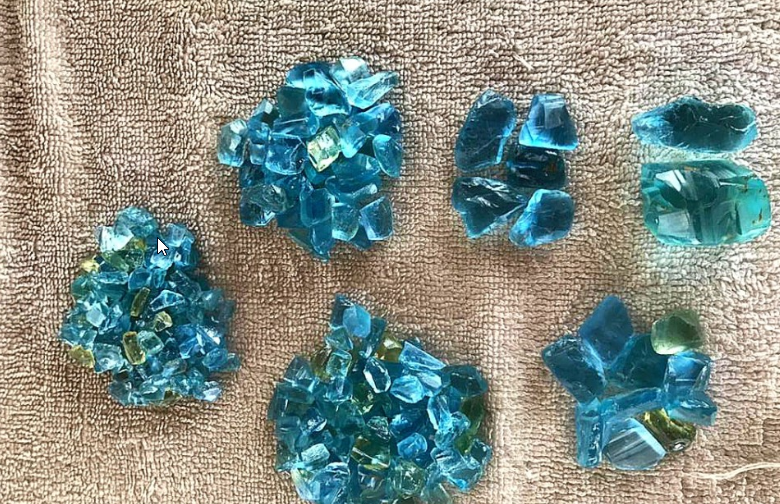
Rough, gem-grade aquamarine crystals collected from informal regional workings, representing the highly speculative micro-economies operating parallel to industrial critical mineral extraction.
In a dusty market corner sparsely filled with vegetables and traditional goods, a man in his thirties remains hunched over, securing a piece of hard ebony wood between his legs. Harvested from trees just beyond his village, he meticulously shapes the delicate face of a woman, his finesse honed over generations evident in every strike of his primitive, homemade chisel. With calloused hands and feet, toughened by a years of carpentry, he adamantly refuses any offer of modern tools, for this is how his art has always been made. Depicting local life – women, children, families, and working men – this type of art adorns rural villages across Mozambique. Each village possesses a similar yet distinctly unique artistic style, reflecting the profound emotions and essence of its people.

A local Mozambican artisan shaping native ebony wood using traditional carpentry tools, practicing a generational craft threatened by aggressive deforestation and shifting socio-economic pressures.
Halfway across the country, in the Zambezi Province, the land is pockmarked by patches of sand, stripped bare of vegetation along a mineral-rich mountain belt that stretches from Mozambique to Tanzania and Kenya. Along this geologically unique occurrence, miners dig in search of a “new gold” – tantalum and niobium. These elements, in the form of tantalite, are prized for their position within a suite of highly sort-after elements defined as Critical Raw Materials by both the European Union and the United States. These, along with many other elements, including cobalt and rare earth elements, form the backbone of the global transition away from fossil fuels, and without which, the Green and Digital transition could not occur. So coveted are these elements, which predominate on the African continent, that countries such as Mozambique (which holds ~17% of the world’s tantalum reserves) have become caught up in a resource tug-of-war that threatens to decimate the local heritage.
Owned by a combination of national and foreign entities, authorised tantalite mines are satellited by numerous, smaller informal mines, euphemistically termed “artisanal mines”. In one such mine, a young boy, no older than 10, digs in the eroded sand with his brother. Though their enthusiasm seems innocent, their digging carries a much darker undertone. What appears as youthful enthusiasm is quickly recognised as desperation, as these boys, and many like them, spend their days sifting through the partially radioactive sediment in search of gem-grade minerals. Synonymous with tantalite mines, boys like them will often sit, perched in the trees, overlooking the mine workings in hopes that the operation will strike a mineralised pocket, which the boys, along with many from the nearby village can exploit under the cover of darkness, sometimes with deadly consequences.
Gems such as aquamarine and pariba tourmaline, which can fetch around $150 and $1000 per gram respectively, are quickly sold to an illicit mineral dealer, colloquially referred to as a “pirate”, who then turns them over onto the international markets within a few days. By facilitating the transfer of wealth to the local population, his role, whilst unintentional, ensures a fragile stability in a region fraught with tension, and thus grants him a level of security.
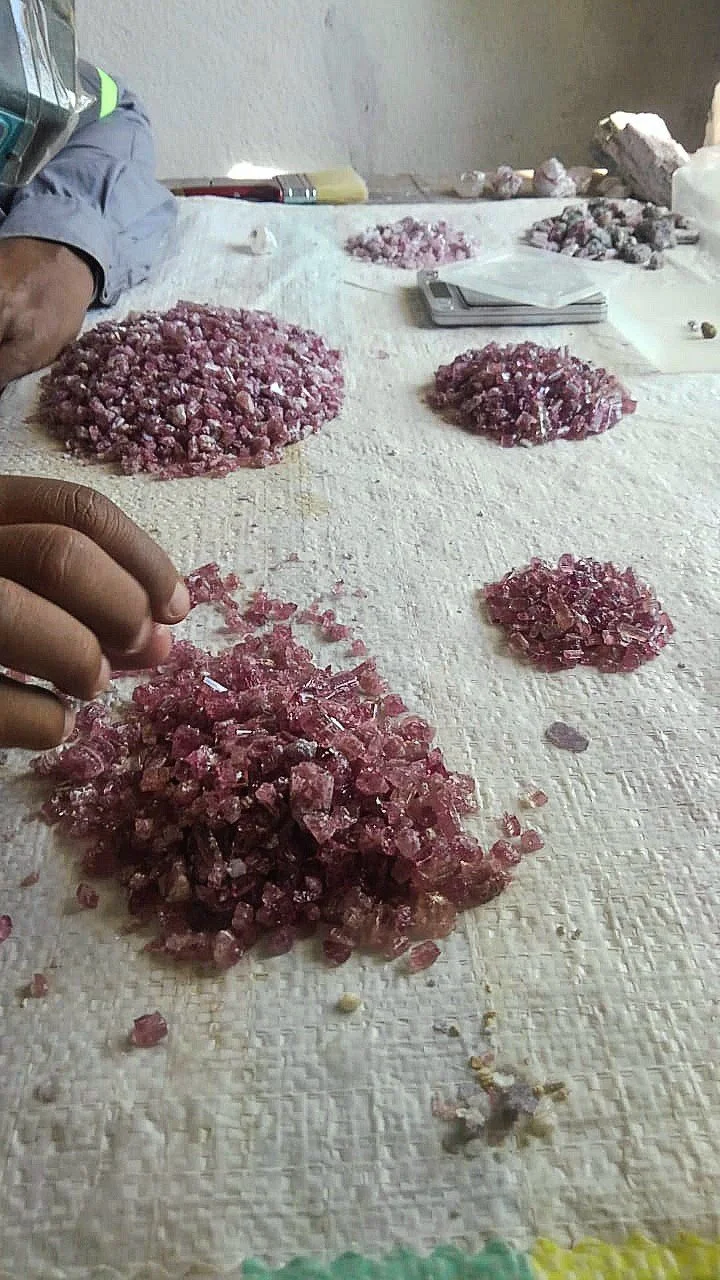
This delicate balance between social welfare and literal survival, is indirectly founded in an unlikely, yet intrinsically cultural source – Ebony trees. Once abundant across East Africa, these hard wood trees provided locals with both expression and income. The prized dark wood, however, has become sought after by foreign countries, particularly in Asia, leading to its recognition as an endangered species only tradable through government-authorised permits. Regardless, acres of forests are felled daily for Chinese consumption, endangering the local environment and eroding the inherent connection between people and their heritage. Unable to create their unique art, many turn to alternative sources of income, with some heading to nearby Naipa and others journeying further to Maputo. Yet, for most, the allure of tourmaline proves too compelling to resist.
As the seasoned carpenter shapes each log into a depiction of his social inheritance, he unwittingly becomes a living testament to a tradition fading under the influence of foreign interests, a dying trade sacrificed on the altar of encroaching greed and corruption. The insatiable demand to secure sources of tantalum and niobium, albeit stemming from well-intentioned policies to transition away from fossil fuels, is coupled with the unending exploitation of ebony forests for foreign markets. This unfortunate, yet inescapable reality has not only disrupted the delicate balance between man and nature but has also cast a long, ominous shadow over the inheritance of generations. As the artistry of local craftsmen fades, replaced by the clamour of mining operations and shady deals, the cultural richness embodied in their creations wanes. The impact reverberates most profoundly on the shoulders of the young, as children, once nurtured by the intimate heritage of their forebears, now find themselves caught in the crossfire of a greedy pursuit that threatens both their innocence and the essence of their cultural birthright. So, we must ask ourselves: In our pursuit of “progress” and “modernity”, are we prepared to reckon with the cost exacted on the very fabric of our shared human legacy?.
Sidenote
Having gained independence from Portugal in 1975, Mozambique has underwent a tumultuous past, marked by a civil war from 1977 to 1992, and three attempted coups d'état in 1980, 1982, and 2000, thus illustrating the multifaceted challenges the country has navigated. As such, the firsthand narratives shared here offer small (albeit abstract) insights into a fraction of a larger and socially intricate ecosystem. An ecosystem delving into issues spanning policy misrepresentation, corruption, international negotiations, and human exploitation, the complexity of which cannot be fully detail in this small piece. Although there is an acknowledged necessity for substantial efforts in local policy development and execution, it is hoped that accounts like the one detailed here will encourage the international community to recognise the comparable significance of addressing both the need and origin of their purchases.